



The Load Shifting is an intelligent strategy to sustainably reduce electricity costs in a company. Through the targeted use of Battery Energy Storage System (BESS) in the Behind-the-Meter (BTM) Operation can electricity consumption be optimized over time – with direct effects on Network charges, electricity procurement costs, and regulatory privileges.
The focus is on electricity tariffs with high-load periods and the so-called atypical grid usage, which offers companies significant savings potential.
What is load shifting?
Load shifting describes the targeted shifting of electricity consumption:
- away from expensive or network-congested times
- until off-peak or grid-relieving time windows
The goal is to use electricity when it is economically and systemically sensible.
In contrast to Peak shaving isn't it primarily about cutting off peak loads, but about the temporal optimization of the overall load profile.
How does load shifting work with BESS?
A battery storage system allows energy to be stored flexibly and provided on demand. To achieve this, a BESS operator strategically utilizes the low and high load times in their grid operator's electricity tariff.
- Charge of the storage in low load times (NLT)
e.g., at low electricity prices or with PV surpluses - Unload during peak load times
e.g., with high prices or network load
This process is controlled by a Energy management system (EMS), the
- Analysis of the last steps
- Peak times are detected
- Electricity prices considered
- automated storage management optimization
Result: A smoothed, economically optimized load profile.
Atypical Grid Usage: The Central Lever
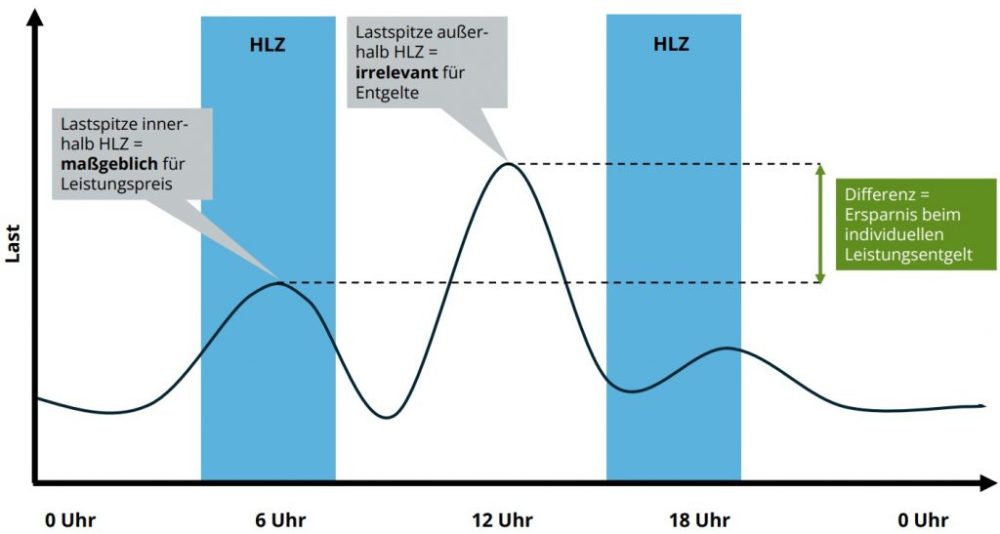
One particularly important application of load shifting is atypical grid usage. It is then present when the annual peak load of a company predictably outside occurring during the peak load window published by the grid operator.
Background:
According to § 19 Paragraph 2 Sentence 1 of the StromNEV, companies can receive individual grid fees if they:
- their electricity consumption specifically outside of defined High load time window relocate
- relieve pressure on the grid during critical times
These peak load times are determined annually by the grid operator and are based on grid load.
Discontinued model: Belt load control
In addition to atypical grid usage, it is still possible to baseload-Regulation to be used in accordance with Section 19, Paragraph 2, Sentence 2 of the StromNEV:
- Prerequisite Over 7,000 operating hours per year
- Goal: as uniform as possible power consumption
- Advantage: Grid fee reductions of up to 90 %
Important: This regulation will be implemented as part of Reform of electricity grid charges (AGNES) from the Federal Network Agency expire. Nevertheless, it remains relevant for many companies.
A BESS supports this by smoothing load fluctuations and enabling more even grid utilization.
The Role of BESS
A BESS enables companies to:
- to specifically reduce electricity consumption during peak load times
- Automatically moving the children
- To continue production processes unchanged
Important: Peak loads outside these time windows are due to atypical grid usage not cost-relevant.
Result:
- Significantly reduced network charges
- Optimized network utilization
- Economical operation without production interventions
Which companies benefit from load shifting?
Load Shifting using BESS is particularly suitable for companies with:
- existing RLM meters and known detailed load profiles
- high power consumption
- Loads that are difficult to move in the NLZ
- Access to dynamic electricity tariffs
- Electricity tariffs with HLZ
The more the load profiles vary, the greater the optimization potential.
Who can use load shifting for atypicality?
Companies with battery storage should consider the following:
1. Materiality threshold
The high-level zone performance must be significantly below the annual peak performance. The Minimum difference depends on the voltage level. These range from extra-high voltage (5%), high voltage (10%), medium voltage (20%), and low voltage (30%), as well as the respective voltage transformation levels.
2. Minimum shift
Regardless of the percentage difference, the actual load shift must be at least 100 kW amount to. This exclusively benefits companies that have a large and technically feasible load shifting potential and can flexibly adjust their load profiles.
3. De minimis limit
The annual savings must be at least 500 Euros amount to economically justify the additional organizational, technical, and administrative effort. Only when this minimum threshold is reached is the implementation expedient from an economic perspective.
4. Deadlines
The application for an individual grid fee must be received by the responsible grid operator no later than September 30 to be considered for the respective billing year. Timely application is a prerequisite for review and approval by the grid operator.
Benefits of Load Shifting with BESS
Even independent of regulatory privileges, load shifting offers clear financial advantages:
- Electricity purchase at cheaper times
- Reduction of grid fees
- Procurement Optimization with Volatile Electricity Prices
- Increasing the self-consumption rate for PV systems
Especially with dynamic electricity tariffs Load shifting is becoming increasingly relevant.
Differentiation from other BTM strategies
In short, load shifting optimizes the timing of electricity consumption. In contrast, the two BTM strategies are:
- Peak Shaving: Targeted reduction of the highest peak load
- Self-consumption optimization: Maximizes the use of self-generated electricity
In practice, these strategies are often combined.
Conclusion: Load shifting makes electricity costs predictable and flexible.
Load shifting with BESS is a key component of modern energy strategies in BTM operation. Through targeted temporal control of electricity consumption, it is possible to:
- Reduce network fees
- leverage regulatory advantages
- Sustainably reduce electricity costs
- Optimize last profile
Especially in combination with own consumption optimization and peak shaving, this creates a holistic, economically highly attractive energy system.
FAQ
What is load shifting?
Load shifting is the targeted displacement of electricity consumption to cheaper or grid-relieved periods.
What does atypical network usage mean?
Companies are specifically reducing their consumption during peak load times and receiving reduced grid fees in return.
How does a BESS help with load shifting?
A battery storage system stores electricity when it's cheap and releases it when needed.
Is load shifting economically viable?
Yes, significant savings can be achieved through lower grid fees and optimized electricity procurement.